
Hi, I'm Sonia,
I have been into astronomy since 1997 when I was 11 years old when comet Hale-Bopp was around. I remember being in the back garden with my dad and he was showing me how to take a photo of it with his old Fujica camera, that I still have now.
Ever since then I've been fascinated with space. I started with a very cheap Tasco telescope from Argos to look at the moon, went onto a Meade goto ETX-90 telescope, which unfortunately due to age stopped working.
I currently use a Skywatcher 10" Dobsonian, to mostly photograph the moon and also the planets. I also have a Seestar S50 which got me into deep sky imaging which I love!
More recently I have also aquired a Seestar S30 and a Vespera II
lastly a Coronado PST for solar imaging.
I have two Bsc (Hons) open degrees in "Introducing Astronomy" and "The Planets"
Elected in 2023 I am a Fellow of the Royal Astronomical Society
Along with my blog for StarDome, I'm also a freelancer for the BBC Sky at Night magazine
and a "Go Stargazing" Astronomer. I am also the director of the British Astronomical Association (BAA) Equipment and Techniques Section
Clear Skies
Sonia
---------------------------------------------------------------------------------------------------------
August 2026
August 2026 is such an exciting month: darkness starts to return, meteor showers and a solar eclipse.
By early August Astronomical darkness begins to return to the UK growing longer each night. The constellations get better, milky way is easier to find and the deep sky objects emerge from the Summer haze.
Sagittarius and it’s famous teapot will be low in the South whilst pouring steam into the Milky Way.
Then we have the Perseid Meteor Shower that will run until late August with the peak on the night of the 12th. Of course clear skies permitting!
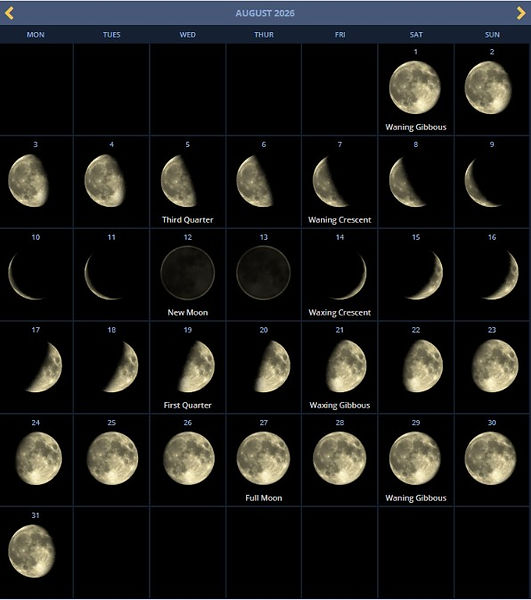
The Perseids are fast, bright and can often leave glowing trails,: this year the peak coincides with a new moon, so perfect conditions.
We also have a rare alignment of a Solar Eclipse on the 12th August in the evening, a deep partial solar eclipse visible across the UK with around 90-94% of the sun will be obscured
(depending on where you are)
The sturgeon moon will rise on the 28th August, but it will rise with a deep partial lunar eclipse. At peak 93-96% of the moons surface will be covered by the moons shadow, turning it a dark red int eh early hours before sunrise.
Planets:
Mercury will be its greatest separation from the sun and will be visible low on the horizon. It rises around 4am
Venus will start to sink low in the twilight and setting 9:30pm. On the 15th August will make a nice view with the crescent moon.
Mars starts to rise around 1:30am at a magnitude of +1.2
Jupiter starts to reappear in the mornings at a magnitude of -1.8 at 4:30am
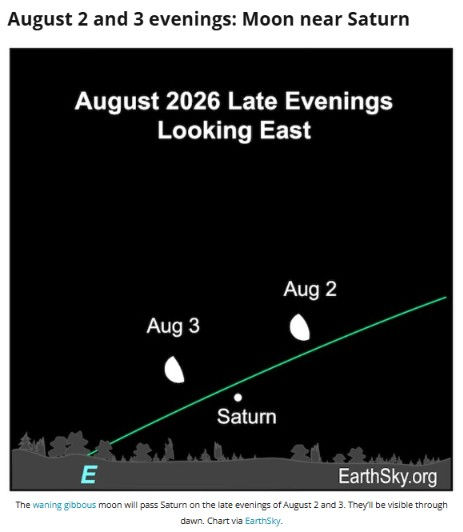
Saturn rises at 10pm at a magnitude +0.6
Uranus at magnitude +5.8 at 11:30pm
Neptune rises 9:30pm at magnitude +7.7, but will need a telescope/binoculars to view.
Constellations of August
Sagittarius dominates the southern sky pointing towards the milky way’s centre
Cygnus, Lyra and Aquila form the Summer triangle, overhead and easy to spot.
Scorpius dips low but with its bright star Antares glows near the horizon.




Solar Eclipse!
12th August
Click here to learn more and the eclipse times for your city.
Remember to look at the sun with protective solar glasses
and solar telescopes with appropriate filters.
https://www.rmg.co.uk/stories/space-astronomy/how-see-12-august-2026-partial-solar-eclipse
Perseid Meteor Shower

The best of the meteors are to be seen from midnight through to the early hours, but some can be seen from when it goes dark. Around 11pm it will be due northeast in constellation of Perseus. Don’t just look at the radiant though, they can appear anywhere in the sky!
Clear skies and have an exciting month of stargazing and phenomena!
Sonia x